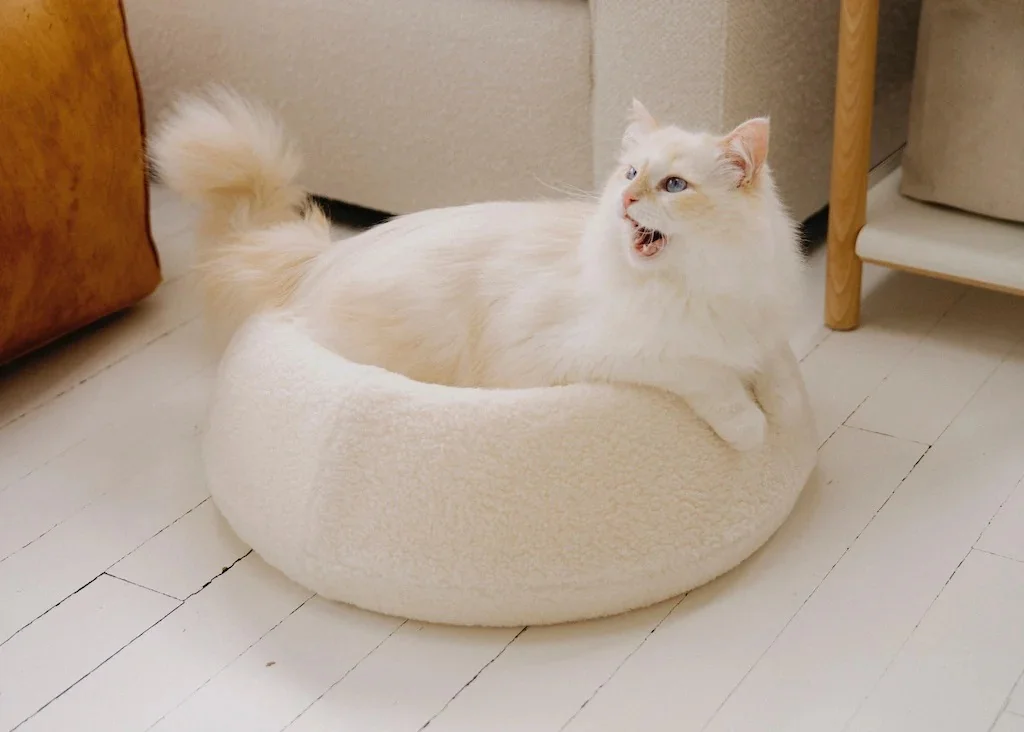

Cats are not mysterious — they are constantly communicating, but mostly in a language humans aren't taught to read. The single most important skill you can develop is distinguishing a content cat from a stressed or fearful one: a relaxed cat has soft eyes, slow blinks, upright tail with a curved tip, and loose body posture. A stressed cat has dilated pupils, tightly tucked tail, tense body, and flattened ears. Any sudden behavior change — increased hiding, aggression, litter box avoidance, or reduced appetite — almost always has a physical or environmental cause, and frequently a veterinary one.
Key Insights
- Cats communicate through a rich combination of body posture, tail position, ear orientation, pupil dilation, vocalisation, and scent marking
- Reading the whole cat simultaneously, not just one signal, gives the most accurate emotional picture
- A purring cat is not necessarily a happy cat. Purring also occurs during stress, pain, and anxiety as a self-soothing mechanism
- Most cat aggression toward humans is defensive, not predatory. Understanding this changes how to respond
- Sudden behaviour changes almost always warrant a veterinary visit to rule out a medical cause before addressing behaviourally. For a detailed guide to reading fear specifically, see our signs of a scared cat article.
- Cats are not being spiteful or vindictive. Every behaviour, including scratching, spraying, and litter box avoidance, has a rational feline explanation
In This Guide
- How Cats Communicate
- Tail Positions and What They Mean
- Ear Positions Decoded
- Eye Signals and the Slow Blink
- Posture and Full-Body Language
- Vocalisation: Meows, Chirps, and Growls
- Signs of Stress and Fear in Cats
- Common Cat Behaviour Problems and Solutions
- Environmental Enrichment for Mental Health
- Frequently Asked Questions
Cats have a reputation for being mysterious and unpredictable, but this reputation is mostly earned by misreading them rather than any genuine inscrutability on their part. Cats communicate with extraordinary precision through a continuous stream of postural, facial, vocal, and olfactory signals. The challenge is that these signals are directed primarily at other cats and operate within a feline communication framework that humans are not instinctively wired to read. Learning the framework changes everything. What looked like random aggression or inexplicable anxiety reveals itself as clearly signalled communication that the cat had been broadcasting for minutes before the situation escalated.
How Cats Communicate
Cats use four primary communication channels simultaneously: body language (posture, tail, ears, whiskers, and eyes), vocalisation (meows, chirps, growls, hisses, and chatters), scent marking (rubbing, scratching, and spraying to leave chemical messages), and touch (allogrooming and allorubbing with trusted companions). Reading any single channel in isolation gives an incomplete picture and frequently leads to misinterpretation.
Context matters as much as the signal itself. A tail held high can indicate confident greeting or potential territorial posturing depending on what the rest of the body is doing. Wide pupils can signal playful excitement or fear depending on whether the body is relaxed or tense. Always read the whole cat in its full situational context rather than isolating individual signals.
Body Language
Posture, tail, ears, whiskers, and spine. The most information-dense channel in feline communication.
Vocalisation
Meows, chirps, trills, chatters, growls, and hisses. Cats developed the meow specifically to communicate with humans.
Eye Contact
Pupil size, blink rate, and gaze direction all communicate emotional state. The slow blink signals trust and contentment.
Scent Marking
Rubbing, scratching, and spraying leave chemical messages invisible to humans but central to feline social communication.
Tail Positions and What They Mean
| Tail Position | Emotional State | What to Do |
|---|---|---|
| High, upright, with slight curve at tip | Confident, happy greeting. "I am friendly and open to interaction." | Reciprocate the greeting. This is an invitation for positive interaction. |
| High and fully erect (bottle brush / puffed) | Extreme fear or arousal. The cat is trying to look larger as a defensive display. | Give the cat space immediately. Do not approach or touch. |
| Wrapped around body or tucked under | Submission, anxiety, or feeling cold and vulnerable. | Assess the environment for stressors. Provide a quiet, safe retreat. |
| Low and slow swish | Focused attention, hunting mode, or mild irritation. | Observe context. If petting, stop. If watching prey, leave alone. |
| Rapid whipping or thumping | Agitation, frustration, escalating arousal. Clear warning signal. | Stop petting immediately. Back off and give space. |
| Relaxed, hanging loosely at roughly half-height | Neutral or relaxed. The cat is comfortable and not significantly aroused in any direction. | Good state for gentle interaction if the cat initiates. |
Ear Positions Decoded
A cat's ears are among its most expressive features and one of the fastest body language channels to change. They can rotate independently through nearly 180 degrees, allowing simultaneous monitoring of two sound sources while maintaining visual focus on a third. Ear position in combination with overall body posture gives you a reliable read of a cat's emotional state in real time.
| Ear Position | What It Communicates |
|---|---|
| Forward, slightly angled outward | Alert, curious, interested. The cat is engaged with its environment positively. |
| Relaxed, neither forward nor back | Calm and comfortable. No considerable emotional arousal. |
| Swivelling independently | Processing multiple sound sources. Normal alert behaviour. |
| Flattened sideways ("airplane ears") | Anxiety, fear, or defensive aggression escalating. Meaningful warning signal. |
| Pinned flat against skull | Maximum fear or defensive aggression. The cat may be about to strike. Stop all approach. |
| Rotated backward (without being flattened) | Mild irritation or increased arousal. Watch for further escalation signals. |
Eye Signals and the Slow Blink
Cats' eyes are extraordinarily expressive once you know what to look for. Pupil size is the most obvious indicator, though it must always be read in context of the ambient light level. In bright light, pupils are naturally narrow slits; in dim light, they dilate regardless of emotional state. The emotional signal comes from pupils that are wider or narrower than the light conditions alone would produce.
Wide pupils in normal or bright light indicate heightened emotional arousal, which could be excitement, fear, or aggression depending on the rest of the body language. Narrowed pupils in dim conditions can indicate displeasure, focused attention, or contentment with slightly squinted eyes. A relaxed cat in normal light often has gently dilated but not maximally wide pupils, and soft, slightly squinted eyes rather than wide-open ones.
Direct, unwavering eye contact between cats is typically a dominance or threat signal. Cats who feel threatened will avoid the gaze of a more dominant cat. In human-cat interaction, this is why many people who are indifferent to cats and avoid looking at them find cats gravitating toward them, while cat lovers who make enthusiastic direct eye contact can inadvertently make cats uncomfortable. Approaching a cat while averting your gaze and allowing the cat to initiate contact is the most effective way to build trust with a nervous or unfamiliar animal.
How to Slow Blink at Your Cat The slow blink is a proven affiliative signal between cats and the humans they trust. To engage in it: sit at a comfortable distance from your cat, let your gaze soften (not a hard stare), and when the cat looks at you, slowly close your eyes completely, hold them closed for a second or two, then open them again. Many cats will respond by slow-blinking back. This simple exchange genuinely strengthens your bond and communicates that you are not a threat. Research published in the journal Scientific Reports confirmed that cats respond positively to the slow blink and that humans using it with unfamiliar cats increased affiliative approaches from those cats.
Posture and Full-Body Language
The overall posture of a cat communicates its fundamental emotional state at a glance. A relaxed cat is loose and fluid in its movements, holds itself at a comfortable, moderate height, and moves without tension. A cat that feels threatened or aggressive holds its body in ways that either make it appear larger (offensive threat) or smaller and protected (defensive fear).
- Relaxed and content: Loose, soft muscle tone. Lying stretched out or curled comfortably. Body exposed, not tucked. Soft expression, possible slow blinking. May be kneading.
- Playful and hunting mode: Low crouch, weight shifted to hindquarters, hindquarters may wiggle before pouncing. Eyes wide and focused. Whiskers forward. Tail may flick slowly.
- Confident approach: Upright posture, tail high, ears forward. Direct, relaxed movement toward the object of interest.
- Fearful and defensive: Body pressed low to the ground or arched away. Tail tucked or bottle-brushed. Ears flattened. Pupils maximally dilated. Whiskers pulled back. May hiss or growl.
- Offensive aggression: Body stiffened and raised, weight forward, direct stare, pupils may be constricted. This posture says "I am willing to attack."
- Overstimulated during petting: Skin rippling along the back, tail beginning to whip, ears rotating backward, body stiffening. These are the pre-bite warning signals most often missed by owners.
Vocalisation: Meows, Chirps, and Growls
Cats developed their vocabulary of meows almost specifically for communicating with humans. Adult cats rarely meow at each other. The meow is a sound shaped through generations of living alongside humans who responded to vocalisation. Your cat has effectively learned to speak to you in the most impactful way available.
Individual cats vary enormously in how vocal they are. Siamese and related oriental breeds are famously talkative. Russian Blues and Scottish Folds are notably quieter. A sudden change in vocalisation patterns, either toward unusual silence or unusual loudness, is worth investigating, as it can signal pain, cognitive decline in older cats, or hearing loss.
| Vocalisation | Likely Meaning |
|---|---|
| Short, high-pitched meow | Greeting. "Hello, I see you." |
| Long, drawn-out meow | Demand or complaint. "I want something and I haven't got it." |
| Trill or chirp | Friendly greeting or attention-seeking, often from a cat approaching its owner. Very positive signal. |
| Chatter (rapid jaw movement) | Watching prey they cannot reach, such as birds through a window. Thought to be frustrated excitement. |
| Purring | Contentment most commonly, but also self-soothing during stress, illness, or pain. Context determines meaning. |
| Growl | Warning. "Back off." Always take seriously and give the cat space. |
| Hiss | Escalated warning or defensive fear. Do not approach a hissing cat. |
| Yowl (long, mournful) | Distress, disorientation (particularly in older cats), territorial calling, or intact cats in heat. |
Signs of Stress and Fear in Cats
Cats are sensitive to environmental change and social pressure. Because they evolved as both predator and prey, their stress response is efficient and their threshold for feeling threatened can be lower than owners expect. Recognising early stress signals allows you to address the cause before the cat's behaviour escalates into aggression, illness, or inappropriate elimination.
Chronic stress in cats is associated with increased risk of feline idiopathic cystitis (FIC), over-grooming leading to alopecia, recurrent upper respiratory infections (the stress-herpes link), and reduced immune function. Managing your cat's stress is not simply a comfort consideration; it is a health consideration.
Early stress signs to watch for include increased hiding, reduced play and exploration, decreased appetite, over-grooming of a specific area, unusual clinginess or the opposite, unusual avoidance of people they normally seek out, excessive vocalisation, and changes in litter box behaviour. None of these are definitive in isolation; any pattern of behaviour change warrants veterinary evaluation before behavioural intervention.
Common Cat Behaviour Problems and Solutions
Scratching Furniture
Scratching is a completely normal, healthy feline behaviour that serves multiple functions: it conditions the claws by removing the dead outer sheath, stretches the muscles of the back and shoulders, and deposits scent from glands in the paw pads, leaving a visual and chemical territorial marker. Cats do not scratch furniture out of spite. They scratch because the item offers the right combination of texture, location, and stability.
The solution is to provide alternatives that are equally or more appealing: sisal-covered scratching posts tall enough for the cat to stretch fully (most commercial posts are too short), placed near the areas where the cat currently scratches. Temporarily covering furniture with double-sided tape or aluminium foil makes those surfaces less appealing while redirecting to the post. Reward use of the post with treats and praise. Nail trimming every two to three weeks reduces the damage caused while redirection is in progress. Soft plastic nail caps (Soft Paws) can be applied by a vet as an additional measure.
Aggression Toward People
Most cat aggression toward people falls into two categories: petting-induced aggression (overstimulation biting) and redirected aggression. Petting-induced aggression occurs when a cat's tolerance for physical contact is exceeded. The cat signals discomfort with a twitching tail, skin rippling, rotating ears, and stiffening body. If these signals are missed and petting continues, biting is the next communication tool available. The solution is to learn and respect your individual cat's body language signals and stop petting before they appear.
Redirected aggression occurs when a cat becomes highly aroused by a stimulus it cannot reach, such as an outdoor cat seen through a window, and redirects that arousal onto the nearest available target, which is often the owner. During a redirected aggression event the cat is genuinely not in a normal cognitive state. Do not attempt to handle the cat. Close off the trigger stimulus (curtain the window), give the cat time to fully calm down in a quiet space, and seek guidance from a veterinary behaviourist if episodes are frequent.
Litter Box Avoidance
Always rule out medical causes first. Urinary tract infections, feline idiopathic cystitis, bladder stones, and arthritis (in older cats) are all common medical drivers of litter box avoidance. A cat going outside the box after previously using it reliably should be seen by a vet before any behavioural intervention is attempted.
If medical causes are excluded, review these common behavioural causes: the box is not scooped frequently enough (minimum once daily, ideally twice), the litter type has been changed, the box is in a high-traffic or noisy location, the box is near the food or water, there are not enough boxes in a multi-cat household (the rule is one box per cat plus one extra), the box is too small for comfortable use, or a stressful event has created a negative association with the box location.
Spraying and Marking
Spraying, the deposition of small amounts of urine on vertical surfaces, is a territorial and social communication behaviour distinct from normal urination. It is most common in intact males but occurs in intact females and neutered cats of both sexes, particularly in response to stress, perceived territorial threats from outdoor cats, and multi-cat household tension. Neutering reduces spraying in most cats but does not eliminate it entirely if the behaviour is already established. Identifying and reducing the stress trigger is more effective than punishment, which simply increases anxiety and worsens the problem. Feliway synthetic pheromone diffusers can reduce stress-related marking in some cats.
Night-Time Vocalisation and Activity
Cats are crepuscular, meaning they are naturally most active at dawn and dusk, not during human sleeping hours. Many cats adjust their schedule to their household's rhythms over time, but others maintain their natural pattern, particularly younger cats with high prey drive. Providing vigorous interactive play using wand toys for 10 to 15 minutes immediately before your own bedtime depletes the cat's energy and predatory drive, reducing overnight activity significantly. Automated feeders set for early morning also reduce dawn vocalisation driven by hunger. In older cats, new or worsening night-time vocalisation warrants veterinary evaluation as it is a common sign of feline cognitive dysfunction syndrome.
Environmental Enrichment for Cat Mental Health
Environmental enrichment is one of the most impactful investments you can make in your cat's behaviour and overall wellbeing. Cats are hunters with complex cognitive needs. A bare apartment with minimal stimulation produces anxiety, stress, and many of the behaviour problems described above. A well-enriched environment gives the cat control, choice, opportunities for natural behaviour, and the mental engagement that their intelligence requires.
- Vertical space: Cat trees, wall shelves, and window perches allow cats to survey their territory from height, which is profoundly calming for a prey animal with both predator and prey instincts. The higher the vantage point, the safer the cat feels.
- Hiding spots: At least one enclosed, safe retreat per cat that no other pet or small child can access. This is the cat's decompression space and must always be available.
- Window entertainment: A bird feeder placed outside a window the cat can safely watch from provides genuine mental enrichment for indoor cats. Bird videos designed for cats offer a substitute where outdoor access is not possible.
- Interactive play: Wand toys that mimic prey movement are the most effective form of enrichment for satisfying predatory drive. Two sessions of 10 to 15 minutes daily is the minimum for most cats, and more for young or high-energy individuals.
- Puzzle feeders: Feeding from a puzzle feeder, lick mat, or scattered-kibble format rather than a bowl engages the cat's foraging instinct and extends the time spent eating, both of which reduce boredom and anxiety.
- Scent enrichment: Rotating toys scented with catnip, silver vine, or valerian, introducing novel safe scents on paper, and allowing supervised outdoor access in a catio or on a harness all stimulate the olfactory system meaningfully.
Sudden Behaviour Change Always Needs a Vet First Any sudden, unexplained change in a cat's behaviour, including new aggression, sudden litter box avoidance, dramatic increase or decrease in vocalisation, sudden lethargy, changes in eating or drinking, or hiding in a cat that is normally sociable, should be evaluated by a veterinarian before attempting any behavioural intervention. Many serious medical conditions including hyperthyroidism, dental pain, urinary tract disease, and neurological problems first present as behaviour changes.