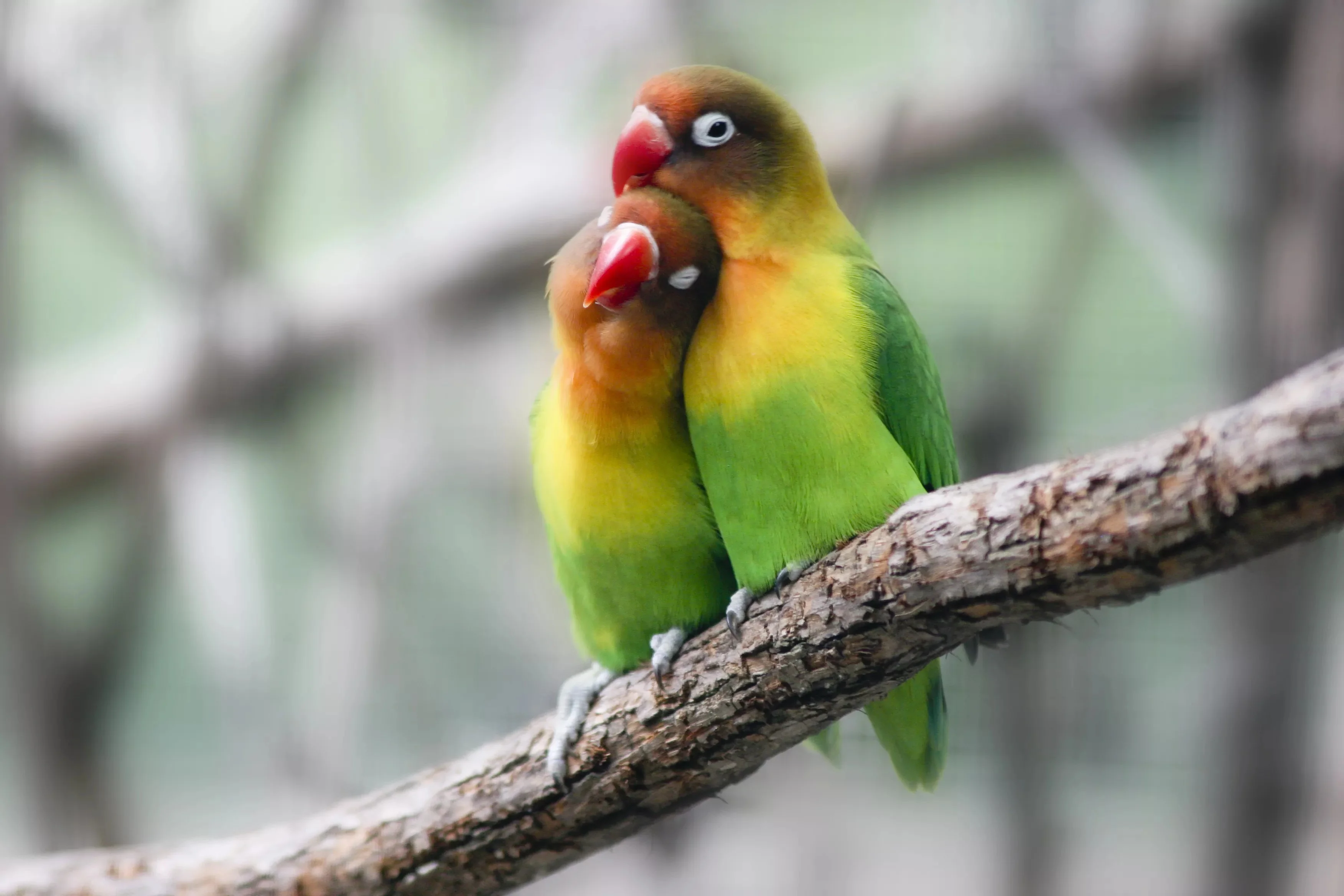

Lovebirds do not strictly need another lovebird to be happy — a single lovebird can live a full, content life when given consistent daily interaction, mental enrichment, and out-of-cage time from you. The deciding factor is your actual schedule, not the species' name: if you are regularly away from home for long stretches, a same-sex bonded pair is the more responsible choice than leaving one bird isolated. The "lovebird" name itself is misleading — it refers to strong pair-bonding behavior in the wild, not a universal requirement for companionship in captivity.
The name "lovebird" sets up a reasonable assumption: surely these birds must be kept in pairs. That belief is one of the most persistent myths in pet bird care, and it leads to real harm in both directions. Some owners feel guilty keeping a single bird and rush into a poorly planned pairing. Others dismiss lovebird social needs entirely, leaving a solo bird understimulated and distressed. Neither extreme serves the bird.
This guide cuts through the confusion. You will find a clear-eyed look at lovebird social biology, practical signs that your current setup is or is not working, and specific strategies whether you keep one bird or two.
Why Lovebirds Have Such Strong Social Needs
In the wild, all nine species of lovebirds (Agapornis) live in large, noisy flocks. They preen one another, forage together, roost shoulder to shoulder, and use constant vocal contact calls to stay connected. Pair bonds within the flock are monogamous and long-term. This wiring does not disappear in captivity.
What changes is the source of that social connection. A hand-reared lovebird that has grown up with human interaction will readily bond with a person as its "flock." A parent-raised bird that has had minimal human contact will find that same connection far more naturally with another bird. This distinction matters enormously when deciding how to house your lovebird.
Species note: The three lovebird species most commonly kept as pets are the peach-faced (Agapornis roseicollis), the Fischer's (Agapornis fischeri), and the black-masked (Agapornis personata). Their temperaments differ slightly, but their social needs are broadly similar. Peach-faced lovebirds are generally considered the most people-oriented of the three.
Can a Single Lovebird Be Happy? The Honest Answer
Yes, with genuine commitment. Many experienced lovebird owners keep single birds that are affectionate, playful, and behaviorally healthy. The key word is commitment. A lovebird kept alone requires its human owner to function as a flock member, which means structured daily time, not casual background presence.
The major upside of a single bird is that it will typically bond far more deeply with you. A hand-raised lovebird kept alone will follow you, seek out physical contact, and actively engage during training sessions. Paired birds, by contrast, tend to direct most of their social energy toward each other and show less interest in human handling. Neither outcome is better in absolute terms; it depends on what you want from the relationship.
What "Enough Interaction" Actually Looks Like
Vague advice to "spend time with your bird" is not useful. Here is what a realistic daily routine for a single lovebird should include:
- At least 2 to 3 out-of-cage sessions totaling 3 or more hours of active presence
- One focused training or trick session of 5 to 10 minutes using positive reinforcement
- Hands-on time: handling, step-up practice, or gentle preening of the head and neck
- Verbal interaction: talking, singing, or narrating your activities near the bird
- Enrichment rotation: at least one new foraging challenge or toy introduced each week
If your typical day does not realistically allow for this, a single lovebird is not the right setup for your household right now.
When Keeping Lovebirds in Pairs Makes More Sense
A companion bird is the better choice in these situations:
- You work full-time away from home and cannot arrange mid-day check-ins
- Your schedule is unpredictable, involving travel or irregular hours
- You want a lovebird primarily to observe natural bird behavior rather than build a hands-on pet relationship
- Your current single bird is showing stress behaviors that have not improved with increased interaction
- Physical limitations make hands-on daily handling genuinely difficult
Avoid opposite-sex pairs unless you are prepared to breed. Lovebirds reproduce readily in captivity. Unplanned clutches create major demands on both the hen's health and your time. For companionship without breeding, always choose two birds of the same sex. Same-sex pairs bond just as closely as male-female pairs.
Are Lovebirds Happier in Pairs? What the Research Suggests
Paired lovebirds tend to exhibit calmer baseline behavior. They can preen each other, share warmth, make contact calls, and engage in mutual foraging, all of which mirror their natural flock life. These activities fulfill social needs in a species-appropriate way that human interaction, however attentive, cannot fully replicate.
That said, "happier" is not the right frame. A well-socialized single bird with enriching daily routines shows every marker of good welfare: healthy weight, full feathering, normal vocalizations, and active curiosity. A poorly matched pair, meanwhile, can develop chronic stress, territorial aggression, and feather damage from fighting. The quality of the social situation matters far more than whether it involves one bird or two.
Signs Your Single Lovebird Needs More Companionship
Lovebirds communicate stress through behavior changes. These are the signals that warrant taking action:
- Feather destructive behavior: Chewing, over-preening, or pulling out feathers, especially from the chest or wings
- Incessant screaming: Loud, prolonged calling that goes well beyond normal contact vocalizations
- Decreased appetite: Eating less or showing no interest in favorite foods
- Lethargy and puffed feathers: Sitting still, sleeping more than usual, or appearing fluffed up outside of cold conditions
- Aggression or withdrawal: Biting without clear provocation, or retreating and hiding when you approach
- Stereotypic behaviors: Pacing, repetitive head-bobbing, or bar-mouthing with no apparent purpose
If you spot one or two of these signs, first spend two to three weeks genuinely increasing daily interaction and enrichment. If the behavior does not improve, consult an avian veterinarian before assuming a companion bird is the solution. Stress behaviors sometimes have medical causes.
Single vs. Paired Lovebirds: Side-by-Side Comparison
| Factor | Single Lovebird | Paired Lovebirds |
|---|---|---|
| Bond with owner | Deeply bonded; treats human as primary flock member | Bonds primarily with mate; less interested in human handling |
| Daily time demand | High: 3+ hours of active presence required | Moderate: birds meet each other's core social needs; still benefits from human interaction |
| Training ease | Generally easier; highly motivated by human attention | Harder; birds may prefer each other's company to treat rewards |
| Main behavioral risk | Stress, feather plucking, screaming if under-stimulated | Pair aggression if incompatible; breeding if opposite sex |
| Minimum cage size | 24" wide x 24" deep x 30" tall | 36" wide x 24" deep x 36" tall with multiple perch stations |
| Best fit | Work-from-home owners, experienced bird keepers, people who want a hands-on pet | Busy households, first-time bird owners, those who prefer to observe natural bird behavior |
How to Keep a Single Lovebird Happy: 6 Evidence-Based Strategies
Hand-feed treats daily
Offer millet spray or small fruit pieces from your palm. This builds trust faster than any other single technique.
Train in short sessions
Five to ten minute step-up and target training sessions, two or three times a day, provide mental stimulation and deepen the bond.
Talk and sing
Lovebirds respond to vocal engagement. Narrate your activities, play soft music, or mimic their contact calls back to them.
Rotate foraging toys weekly
Puzzle feeders, shreddable items, and foraging boxes prevent boredom and replace stimulation they would otherwise get from a flock.
Place the cage socially
Put the cage in a room where family activity happens naturally, but avoid kitchens (fumes) and high-traffic areas with unpredictable noise.
Keep a consistent schedule
Birds are creatures of routine. Predictable feeding times, wake-up sounds, and out-of-cage windows reduce background anxiety significantly.
Where to pet a lovebird safely: Stick to the head and neck when handling your bird. Stroking the back, under the wings, or near the tail activates hormonal responses linked to mating behavior, which can cause long-term behavioral problems in solo birds. Head scratches and beak-to-finger interactions are the appropriate equivalent of lovebird-to-lovebird preening.
How to Introduce a Companion Bird Safely
Introducing a second lovebird to an established bird requires patience. Skipping steps causes fighting and failed pairings that can be very difficult to reverse.
- Quarantine the new bird for 30 to 45 days in a completely separate room. This protects your existing bird from any illness the newcomer may carry, including respiratory infections and parasites.
- Move cages side by side once quarantine is complete. Let the birds see, hear, and smell each other through cage bars for one to two weeks before any physical contact.
- Introduce in neutral territory. Use a play gym or area neither bird considers its own. Keep the first sessions to 15 to 20 minutes and watch body language continuously.
- Read the body language carefully. Mutual preening and shared perching are positive signs. Puffed feathers, chasing, feather biting, or one bird pinning another to the floor are reasons to separate immediately and slow down the timeline.
- Maintain separate cages initially. Even once the birds tolerate shared space during supervised time, keep them in separate cages at night until you are confident they will not fight when unsupervised.
- Transition to a shared cage gradually when both birds are consistently relaxed in each other's presence. Use a cage that is new to both birds rather than putting the newcomer into the established bird's territory.
Some introductions take days. Others take months. The temperament of each individual bird matters more than their sex, age, or species variant. Do not rush the process based on how well things look in short supervised sessions.
What Happens to a Lovebird When Its Partner Dies?
There is a popular belief that lovebirds die of a broken heart when they lose a mate. This is a myth, but the underlying concern about grief is not unfounded. A lovebird that loses its bonded partner may show genuine behavioral changes: reduced appetite, increased quiet, or searching behavior. This is real grief, and it deserves a real response.
In the wild, a lovebird that loses its mate will typically re-pair within the flock. In captivity, that option does not exist without intervention. If your bird has lost a companion, increase your own interaction time immediately and observe closely for stress behaviors. If symptoms persist beyond a few weeks, consult your avian vet. Introducing a new companion is an option, but follow the same gradual process described above. A bird in a state of grief is not necessarily ready to accept a new cage mate quickly.
Lovebird Companionship and Lifespan: A Long-Term Perspective
Lovebirds live 10 to 15 years in healthy captivity, with some individuals reaching beyond that. Before choosing between a single bird or a pair, think through your life over that timeframe. A job that keeps you home today may change. A schedule that allows four hours of daily interaction now may not look the same in three years.
This is one of the more convincing arguments for starting with a same-sex pair from the beginning, particularly for first-time owners. It removes the dependency on your consistent availability and protects the bird's welfare even as your life circumstances shift. A bird that has never had a feathered companion, then loses regular human contact due to a schedule change, faces a harder adjustment than one that has always had a bird partner.
📚 Related Guides on PetSymptoms
❓ Frequently Asked Questions About Lovebird Companionship
Get the Complete Lovebird Care Picture
Companionship is foundational, but it is only one part of keeping a lovebird well. Diet, cage setup, health monitoring, and training all play an equally important role.
Read the Full Lovebird Care Guide →