Key Facts
- AKC Herding Group breed, officially recognised in 2015, descended from small Australian Shepherds
- Height 13 to 18 inches; weight 20 to 40 pounds, making them one of the most practical-sized herding breeds
- Exceptional trainability and dog sport performance in a manageable frame
- The MDR1 (ABCB1) gene mutation is prevalent in the breed and makes certain common medications potentially fatal. DNA testing every MAS is non-negotiable
- Requires at least 45 to 60 minutes of vigorous daily exercise plus structured mental stimulation. Not suited to sedentary households
- Herding instincts toward children, small pets, and moving objects require consistent management from puppyhood
The Miniature American Shepherd has an almost unfair advantage in the dog world: it delivers the intelligence, athleticism, and trainability of a full-size herding dog in a size that fits comfortably in most cars, homes, and lifestyles. This is an honest advantage, not a compromise. The MAS is not a watered-down shepherd; it is a fully capable working breed that happens to come in a practical package. But with that capability comes the same demands that make any high-intelligence herding breed challenging to live with when those demands are not understood or met.
Breed Snapshot
Miniature American Shepherd at a Glance
AKC Group
Herding
AKC Recognition
2015
Height
Males: 14–18 in
Females: 13–17 in
Weight
20–40 lb
Lifespan
12–13 years
Coat
Medium-length double coat; straight or wavy
Colours
Black, red, blue merle, red merle; with white and/or tan markings
Energy Level
High
Exercise Needed
45–60 min vigorous daily + mental stimulation
Trainability
Exceptional
Shedding
Moderate to heavy
Critical Health Note
MDR1 gene mutation: DNA test all dogs
History and Origins
The Miniature American Shepherd was developed in the United States in the 1960s, primarily in California. Breed developers selected the smallest, most athletic individuals from Australian Shepherd lines and bred them selectively over several generations to produce a consistently smaller dog that retained the herding ability, intelligence, and work ethic of the full-size Australian Shepherd. The breed was originally known as the Miniature Australian Shepherd, but as it developed its own distinct breeding population, type, and breed standard, advocacy for separate recognition grew.
The breed earned AKC recognition in 2015 and was placed in the Herding Group. This formal recognition represented the culmination of decades of selective breeding by dedicated breeders who maintained the breed's working character while establishing consistent size and type. Today the MAS competes successfully across a wide range of AKC dog sports including agility, obedience, herding trials, tracking, and canine freestyle, consistently demonstrating the full working capability of its larger ancestry.
Appearance and Coat Colours
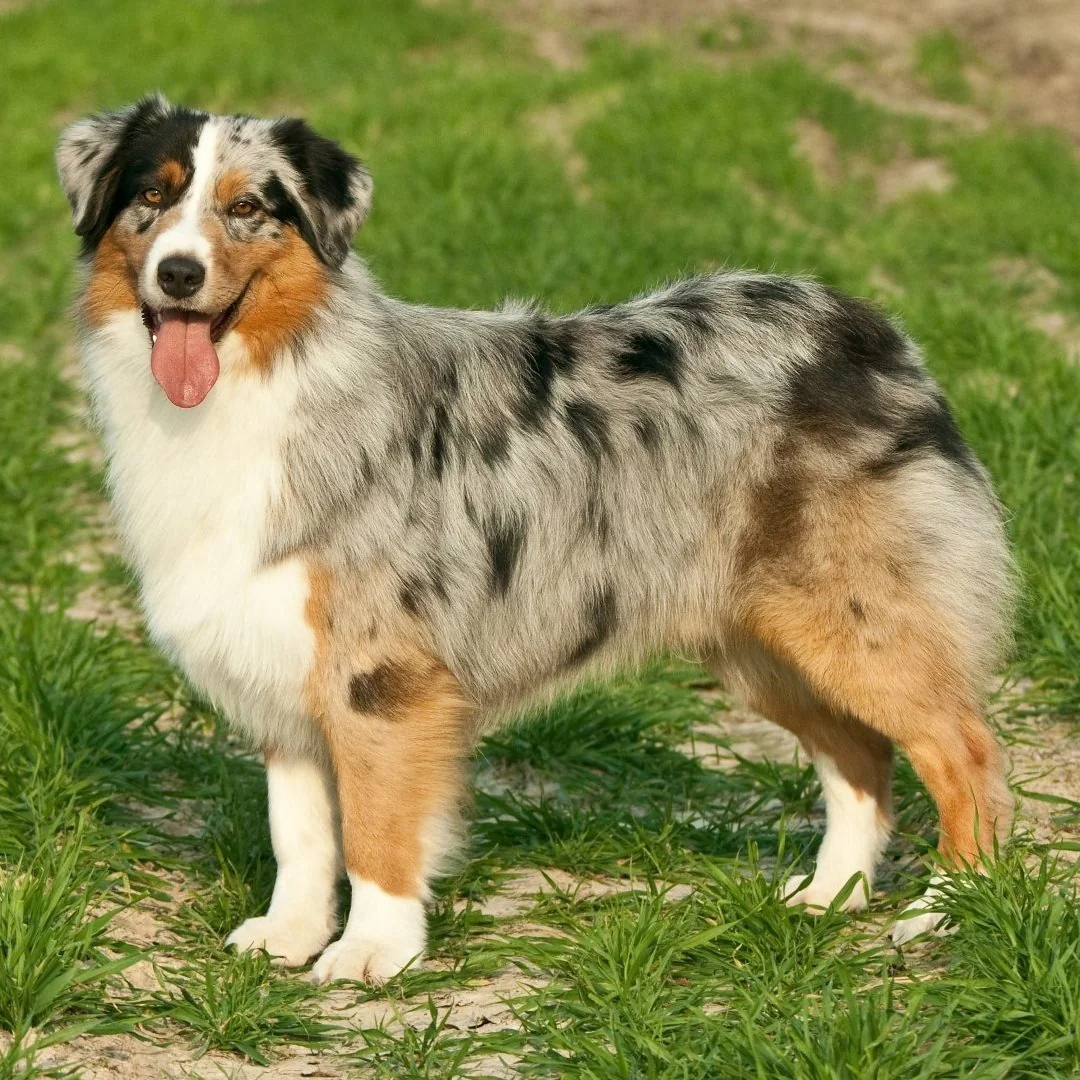
The Miniature American Shepherd is a well-proportioned, athletic dog that looks exactly like a scaled-down Australian Shepherd. Males stand 14 to 18 inches at the withers and typically weigh 25 to 40 pounds. Females are slightly smaller at 13 to 17 inches and 20 to 35 pounds. The body is slightly longer than it is tall, reflecting the low-centre-of-gravity build designed for agile herding work over uneven terrain.
The coat is medium-length, dense, and double-layered. The outer coat is straight to slightly wavy and weather-resistant. The undercoat is soft and provides insulation in both cold and moderate heat. There is pronounced feathering on the back of the forelegs, the breeches, and around the collar area. The coat requires regular brushing to prevent matting, particularly in the feathered areas and behind the ears.
The AKC recognises four base coat colours:
Black Red (Liver) Blue Merle Red MerleAll four colours may appear with white and/or copper (tan) markings. Merle coats have a marbled, mottled appearance where darker patches appear against a lighter background in the same base colour family. Eyes in merle dogs may be blue, partially blue, or marbled, which is a characteristic of the merle pattern rather than a health concern in single merle dogs.
When two merle-coated dogs are bred (double merle pairing), statistically 25% of the offspring will be homozygous merle (double merle). Double merle dogs carry a very high risk of severe vision and hearing deficits, including complete blindness and deafness, due to the absence of pigment-producing cells in the eyes and inner ear. Responsible breeders always pair merle dogs with solid-coloured mates. Any breeder producing double merle puppies is not following responsible breeding practices.
Temperament and Personality
The Miniature American Shepherd is an energetic, highly intelligent, deeply loyal breed with a personality that rewards owners who engage with them fully and challenges those who do not. They form intense bonds with their primary family — a quality that can tip into separation anxiety without early independence conditioning and are naturally affectionate and playful within that circle. With strangers they tend to be reserved and watchful initially rather than immediately open, which is typical of herding breeds with guardian instincts.
Their herding instinct is real and active even in dogs with no livestock exposure. Without appropriate outlets, this instinct redirects toward children, other pets, cyclists, and any moving object in the environment. Eye-stalking, crouching, nipping at heels, and circling are classic herding behaviours that appear in MAS dogs in domestic settings. These behaviours are not aggression; they are instinct. But they require consistent management and redirection from puppyhood to prevent frustration and injury, particularly with small children or cats.
Their intelligence is a defining characteristic and a practical challenge. The MAS learns extraordinarily fast, which means problem-solving skills, escape plans, and undesirable habits form just as quickly as desirable ones. An under-stimulated MAS will find its own entertainment, and that entertainment is rarely welcome. Their emotional sensitivity means they read human stress and emotion accurately and can become anxious in turbulent households.
Exercise and Mental Stimulation Needs
Despite their smaller size compared to full-size herding breeds, the MAS has an exercise requirement that reflects its herding heritage, not its body weight. At least 45 to 60 minutes of vigorous physical activity per day is the baseline for an adult MAS. This should include off-lead running, active games, or structured sport sessions rather than simply walking. A walked MAS that does not get to run and problem-solve is typically an under-exercised MAS, regardless of the distance covered.
Mental stimulation is equally important. The MAS's intelligence needs daily engagement through training sessions, dog sports, puzzle toys, nosework, or any activity that requires thinking and decision-making. A physically exercised but mentally idle MAS will frequently develop anxiety, compulsive behaviours, and destructive habits. Many MAS owners who struggle with the breed later report that doubling the mental stimulation made more difference than adding more physical exercise.
Dog sports are an ideal outlet for the MAS's combination of intelligence, athleticism, and desire to work with their handler. Agility, competitive obedience, herding trials, flyball, disc dog, nosework, and canine freestyle are all disciplines in which MAS dogs consistently excel. Participating in these activities is genuinely the best way to give this breed a satisfying daily life.
Training the Miniature American Shepherd
The MAS is among the most trainable breeds you will encounter — start with our dog training basics guide for the essential foundation. They pick up new behaviours quickly, retain them reliably, and genuinely enjoy the training process when it is conducted with positive reinforcement and clear communication. Their high food motivation and desire to engage with their handler makes them fun, responsive training partners.
Start training from the first day the puppy arrives home. The MAS's intelligence means habits, both desirable and undesirable, form quickly and become entrenched. Early impulse control training, socialisation to diverse environments and people, and establishing a reliable recall are the highest priorities in the first weeks.
The MAS's intelligence is also an attention span challenge. Repetitive drills bore them quickly. Keep training sessions to 5 to 10 minutes and vary the exercises within each session. End on a success. Introduce new challenges regularly to maintain engagement. The same intelligence that makes them easy to teach fundamentals makes them susceptible to boredom with repetitive routines.
Socialisation requires specific attention with this breed. The MAS's natural reserve with strangers means that under-socialised individuals can become fearful, reactive, or difficult to manage in public settings. Every positive exposure to new people, environments, sounds, and animals during the critical window between 8 and 16 weeks builds the neural foundation for confidence as an adult. Do not skip this process or wait until vaccinations are complete to begin, as the window closes before full vaccine protection is established. Carry the puppy or arrange safe, clean environments for early socialisation alongside the vaccine schedule.
Grooming and Coat Care
The MAS's medium-length double coat requires brushing two to three times per week to prevent matting, remove loose undercoat, and keep the feathering tangle-free. The areas behind the ears, in the armpits, and in the breeches (rear leg feathering) are most prone to matting and need particular attention. During the two annual heavy shedding periods in spring and autumn, daily brushing with an undercoat rake significantly reduces the amount of hair distributed around the home.
Bathing every four to six weeks keeps the coat clean and reduces shedding. The dense double coat takes time to dry thoroughly. A high-velocity dryer speeds this up and also helps blow out loose undercoat. Never shave a MAS's double coat. The double coat provides insulation in both cold and warm weather and protects the skin from sun exposure. Shaving it disrupts the natural coat function and can permanently alter texture on regrowth.
Regular ear checks, nail trimming every three to four weeks, and dental care including brushing or dental chews complete the grooming routine. Eyes should be checked periodically for discharge, cloudiness, or signs of irritation, particularly given the breed's predisposition to certain eye conditions.
Health Issues and the Critical MDR1 Gene
The MDR1 gene (also called ABCB1) mutation is prevalent in the Miniature American Shepherd and other herding breeds. Dogs carrying this mutation have reduced ability to pump certain drugs out of the brain, meaning medications that are safe for most dogs can cause severe neurological toxicity, including seizures, disorientation, and death, in MDR1-affected dogs. Affected medications include ivermectin (found in many heartworm preventatives), loperamide (Imodium), certain chemotherapy agents, and several other common drugs. DNA testing to determine every MAS's MDR1 status before veterinary treatment is not optional, it is a patient safety requirement. Inform every veterinarian you visit of your dog's status.
| Condition | Description | Testing Available? |
|---|---|---|
| MDR1 Gene Mutation | Reduces drug efflux from the brain, causing toxicity with certain medications. Can be fatal. | Yes. DNA test. Required for all MAS dogs before veterinary medication. |
| Hip Dysplasia | Abnormal hip joint development causing pain, lameness, and early osteoarthritis. | OFA hip evaluation required for CHIC health clearances. Buy from OFA-cleared parents. |
| Collie Eye Anomaly (CEA) | Hereditary eye development abnormality ranging from mild to severe vision loss depending on severity of choroidal hypoplasia. | DNA test available. Both parents should be tested before breeding. |
| Progressive Retinal Atrophy (PRA) | Hereditary degeneration of the retina leading to progressive loss of vision, starting with night vision. | DNA test (PRA-PRCD) available. Reputable breeders test both parents. |
| Double Merle (if bred) | Homozygous merle offspring from merle x merle pairings; high risk of blindness and deafness. | Prevented by responsible breeding practices: never pair two merle dogs. |
| Epilepsy | Some herding breeds have elevated rates of idiopathic epilepsy. Monitor for seizure activity and report promptly to a vet. | No specific DNA test; MRI and neurological workup if seizures occur. |
Choosing a Healthy Miniature American Shepherd Puppy
Reputable MAS breeders conduct the following health testing on their breeding dogs before producing a litter: OFA hip evaluation, OFA CAER eye examination, DNA test for MDR1 mutation, DNA test for PRA-PRCD, and DNA test for Collie Eye Anomaly (CEA). Breeders participating in the AKC Canine Health Information Center (CHIC) programme meet a published minimum health testing standard. Ask to see health clearance documentation for both the dam and sire of any litter you consider. A breeder unable to provide these documents is not health testing their breeding stock.
When visiting a litter, look for puppies that are alert, curious, and confident in approaching you without excessive hesitation. Avoid the most fearful or the most aggressive and dominant puppy in the litter. A middle-of-the-road temperament is generally easiest to live with and most representative of the breed's ideal character. Ask the breeder whether both parents have been DNA tested for MDR1 and request copies of those test results.
Is the Miniature American Shepherd Right for You?
The MAS is an outstanding dog for the right owner and a clear challenge for the wrong one. The right owner is active, enjoys training and dog sports, has time for daily mental and physical engagement, and finds the intelligence and responsiveness of a herding breed rewarding rather than overwhelming. The MAS thrives in these homes and rewards committed owners with a level of connection and versatility that few breeds can match.
The wrong owner is looking for a low-maintenance companion dog that will entertain itself, is away from home for long hours daily, has very young children who will be subject to herding and nipping, or is not prepared to maintain consistent training throughout the dog's life. Under these circumstances, even the most well-bred MAS typically develops behavioural challenges that become increasingly difficult to manage.
Frequently Asked Questions
Is the Miniature American Shepherd the same as a Mini Australian Shepherd?
The MAS descended from small Australian Shepherds but is now a separately AKC-recognised breed with its own breed standard, officially accepted into the Herding Group in 2015. While closely related and visually similar, the MAS is bred to its own standard and registered separately. The informal name Mini Australian Shepherd or Mini Aussie is still used in some contexts but technically refers to the MAS as a distinct breed.
What is the MDR1 gene and why does it matter for Miniature American Shepherds?
The MDR1 (ABCB1) gene mutation causes dogs to have reduced ability to pump certain drugs out of the brain, meaning medications that are safe for most dogs can cause severe neurological toxicity, including seizures and death, in affected dogs. Commonly used medications including ivermectin in some heartworm preventatives, loperamide (Imodium), and certain chemotherapy drugs are dangerous to MDR1-affected dogs. DNA testing every MAS is essential before any veterinary treatment, and every vet seeing the dog must be informed of its MDR1 status.
How much exercise does a Miniature American Shepherd need?
Despite their compact size, MAS dogs need at least 45 to 60 minutes of vigorous daily exercise plus marked mental stimulation. They are a working herding breed with high drive and intelligence, and they become bored, anxious, and destructive when their needs are not met. Dog sports including agility, obedience, herding, and nosework are excellent outlets. The MAS is not well-suited to sedentary households regardless of their smaller size.
Are Miniature American Shepherds good for first-time dog owners?
The MAS can work for first-time owners who are active, committed to training, and willing to research the breed's specific needs before getting one. They are highly trainable and eager to please, which makes the learning curve manageable. However, their intelligence, herding instincts, and energy level require significantly more daily investment than many companion breeds. Honest lifestyle assessment before purchase is essential.
What coat colours do Miniature American Shepherds come in?
Miniature American Shepherds come in four AKC-recognised base colours: black, red (liver), blue merle, and red merle. Many also have white and/or copper tan markings. Two merle dogs must never be bred together as double merle offspring carry a very high risk of blindness and deafness. Responsible breeders always pair a merle dog with a solid-coloured mate.
Medical disclaimer: This article is for educational purposes only and does not constitute veterinary advice. Always consult a licensed veterinarian for diagnosis and treatment of your pet's health conditions.